
A text says what happened. A letter says you thought about how to say it. That difference is the entire case for a digital love letter: not that it looks nicer than a message, but that writing one takes long enough to force you to actually think about what you're saying.
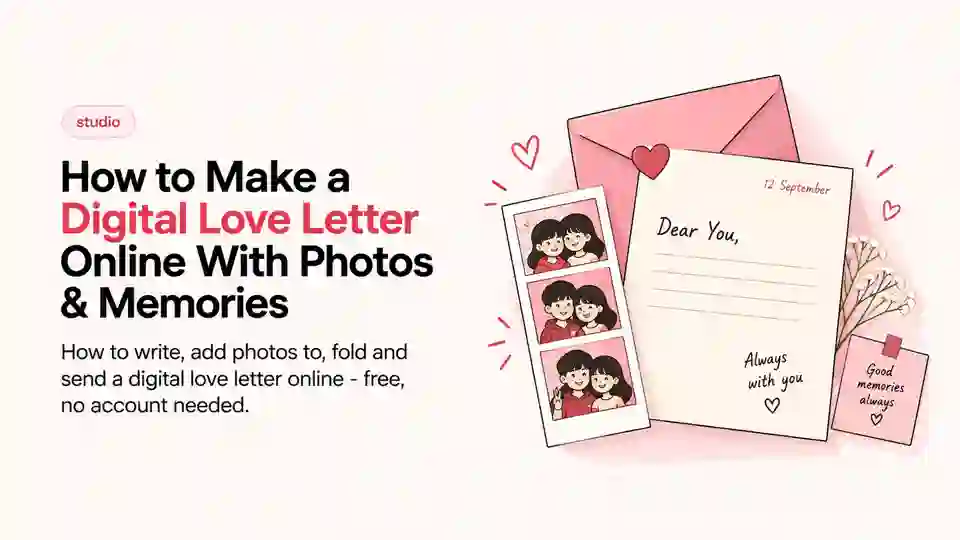
LensBooth Letters is a realistic digital paper letter you write directly on the page, attach photos to, fold, and put into an envelope before sending. This is what it's for, what to put in one, and how to make one.
What is a digital love letter?
It's a letter that keeps the physical gestures of a real one - writing on a page, folding it, sealing it in an envelope - but is made and sent online. The point isn't to imitate paper for its own sake. It's that those gestures are what make a letter feel like an event rather than a message: you sit down, you write, you fold it closed, and only then does it go anywhere.
A digital love letter isn't only for couples, despite the name. The same format works for a friend who moved away, a parent, a thank-you note that deserves more than a text - anywhere a normal message would feel too quick for what you're actually trying to say.
It also solves a specific problem a normal message can't: a photo strip or photo on its own has no context once it's a week old, and a message on its own has no image to anchor it. A letter puts both on the same page, so the photo explains the words and the words explain the photo. Neither one needs a caption doing all the work.
What to put in a digital love letter
A blank page is the hardest part of any letter. A few things worth including, in whatever combination fits:
- The actual message. Obvious, but it's worth deciding first whether this is a letter about a specific thing (a trip, an anniversary, an apology) or a general one, because that changes how you open it.
- A favorite photo, or a photo strip. A single image tied to the letter's subject does more work than a paragraph describing it.
- A meaningful date. When you met, when something happened, or just today's date written the way you'd write it by hand.
- A location. Where you are, where they are, or where the memory took place.
- Small decorations or stickers. Not required, but they're what stop a letter looking like a printed document.
- An inside joke or specific memory. The single most effective way to make a letter feel like it could only have been written to one person.
How to create one in LensBooth
The actual process, start to finish:
- Open Letters in Studio. Go to LensBooth Letters to start.
- Start a letter. You'll land on a blank page ready to write on.
- Write your message. Type directly onto the paper.
- Add photos or photo strips. Upload an existing photo, or attach a photo strip you've already made in LensBooth.
- Adjust what you've added. Resize and reposition the supported elements - photo, date, location, decorations - until the page looks right.
- Fold the letter. Once you're happy with it, fold it the way you would a physical letter.
- Place it in the envelope and send. Share it using one of the supported outputs, or save it.
The whole thing takes a few minutes. Nothing about it requires an account, and there's no software to install - it runs in the browser, on desktop or mobile.
Digital love letter ideas
A few starting points, if you're staring at a blank page:
- Long-distance relationship. A regular letter, on no particular occasion, is often more meaningful than one tied to an event - it says you were thinking of them on an ordinary day.
- Anniversary. Pair it with a photo strip from the actual date, or from as close to it as you have.
- Birthday. A letter reads as more considered than a card, without much more effort.
- Travel memory. Written while somewhere, or written afterward about somewhere - both work.
- First-date memory. Revisiting the specifics of how something started tends to land better than a general "I love you."
- A thank-you note. For something that a text would undersell.
- A letter to a friend. The format isn't romantic by default - it works just as well for friendship as for a relationship.
These are starting points, not features of the tool itself - what you write is entirely up to you. The format works whether the occasion is large or nonexistent; a letter written for no particular reason, on an ordinary Tuesday, often reads as more genuine than one written because a date on the calendar required it.
Digital letter vs. sending a normal message
Neither is objectively better; they do different jobs.
| Digital letter | Normal message | |
|---|---|---|
| Time to send | A few minutes | Seconds |
| Feels like | An event | A conversation |
| Best for | Something considered | Something quick |
| Carries photos well | Yes, built in | Attached separately |
| Reread later | Feels intentional | Gets lost in the thread |
A normal message is right for most of a day's communication. A letter is right for the handful of things worth more than a normal message.
If you'd rather record than write
Not every message wants to be written. If what you're trying to send is your actual voice rather than your handwriting, a digital cassette does the same job with a recording instead of a page - the same idea of something built to be kept, not just read once and forgotten.
Frequently Asked Questions
What is a digital love letter?
A letter written on a realistic digital paper page, with photos, a date and small decorations added, then physically folded and placed into an envelope before it is shared - the digital version keeps the gestures of a real letter rather than replacing them with a form.
Can I add photos to a digital letter?
Yes. You can add or upload photos or photo strips, then resize and reposition them on the page.
Can I make a digital letter for a friend?
Yes. It isn't limited to romantic messages - the same format works for friends, family, or anyone a normal message would undersell.
Can I share a digital love letter online?
Yes, using the supported sharing options once the letter is finished, or you can save it.