
A digital memory can mean almost nothing. A screenshot nobody reopens, a photo buried three thousand deep in a camera roll, a message thread that scrolls past in a week. It can also mean something you actually go back to - a letter you can reread, a voice you can hear again, a stranger's thirty-second message that stops you mid-scroll. The difference is rarely the platform. It is the format.
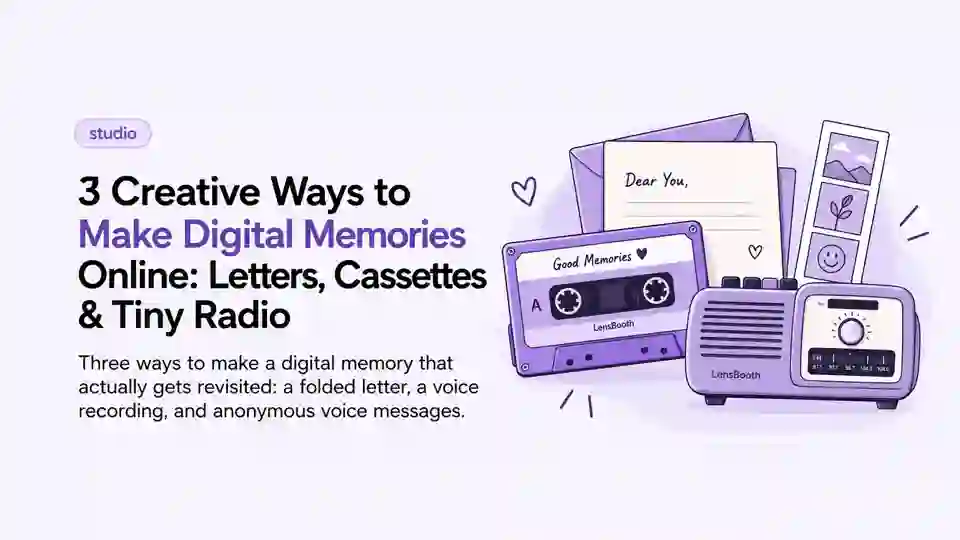
LensBooth's Studio has three formats built around that idea: a digital letter you write and fold like paper, a digital cassette you record your actual voice onto, and LensBooth Radio, where you hear voice messages left by strangers and can leave one of your own. None of them are a photo gallery with extra steps. Each does something a photo can't.
This is a short guide to what each one is actually for, with a link to each experience and to a longer walkthrough of each.
What makes a digital memory feel personal?
Three ingredients do most of the work, and each format below leans on a different one.
Words carry intention. Typing a message takes seconds; writing one out, choosing what to say and what to leave unsaid, takes longer and shows it. A letter is slower on purpose.
Photos carry a moment. Not the whole story, just the fifteenth of a second something happened. A photo strip or snapshot dropped into a letter or onto a cassette label anchors the words to something that actually took place.
Voice carries a person. Tone, pace, the pause before a sentence, a laugh that cuts off - none of that survives in text. A recording does what a transcript of the same words never could.
A letter, a cassette and a radio message combine these in different proportions. That's the actual reason to pick one over another - not which is "better," but which ingredient the moment needs.
None of the three take long to make. That matters more than it sounds - most digital memories that never get made die at the planning stage, not the execution. A letter takes a few minutes to write and fold. A cassette recording is however long your voice message runs. LensBooth Radio takes about as long as it takes to say something. The barrier is closer to zero than picking up an actual pen or a real cassette recorder ever was.
1. Make a digital letter
LensBooth Letters is a realistic digital paper letter. You write directly on the page, add or upload photos and photo strips, resize and reposition them, and add a date, a location and small stickers or decorations. When it's done, you fold the letter and place it into an envelope, the same physical gestures as a real one, then share or save it.
It suits the situations where a message alone feels thin: a long-distance relationship, a birthday, an anniversary, a friend who moved away, a travel memory you want to hand someone rather than send. The photo strip is what turns "I wrote you a letter" into "I wrote you a letter about that afternoon."
Read the full walkthrough in how to make a digital love letter online, or open LensBooth Letters and start one.
2. Turn a voice message into a digital cassette
A voice note is convenient and disposable - it sits in a chat thread until it scrolls away. A cassette is the same recording given somewhere to live. You customize the cassette's cover and label, add one photo you can crop and reposition, write a short line of text and an optional date, then record your actual voice: pause, resume, stop, preview, and re-record until it's right.
The part that makes it feel different from a normal voice message is what happens on the other end. The receiver doesn't just tap play - they watch the cassette slide into a player before it starts, the same small ritual as putting on a tape.
Read the full walkthrough in how to make a digital cassette with your voice, or open LensBooth Cassette and record one.
3. Listen to anonymous voices on LensBooth Radio
LensBooth Radio is a vintage tabletop radio on the page. Tune the dial and you hear a real recorded voice message left by someone you'll never meet - the FM frequency picks a message rather than a station. Pause, replay, mute or adjust the volume, and press Next Stranger to move on to someone else's.
If you want to leave something of your own, you can record a message, preview it, re-record if you want to change it, and broadcast it into the same pool other people are tuning into. Every message is automatically checked for safety before anyone else can hear it - nothing goes out unreviewed.
Read the full walkthrough in hear anonymous voice messages from strangers online, or open LensBooth Radio and tune in.
Which format should you use?
This isn't a ranking - the three do different jobs. A rough guide to which fits what you're after:
| If you want to... | Try... |
|---|---|
| Write something personal, slowly | Letters |
| Preserve your actual voice, with a photo attached | Cassette |
| Discover a stranger's voice, or leave one for someone else | LensBooth Radio |
| Say something to one specific person | Letters or Cassette |
| Say something to no one in particular | LensBooth Radio |
Nothing stops you from using more than one. A letter for the words, a cassette for the voice attached to the same occasion, and LensBooth Radio for the days you just want to hear someone you'll never meet - they solve different problems and don't compete with each other.
More ways to make digital memories
If letters, cassettes and anonymous radio messages aren't quite what you're after, a few more ideas from around the site:
- 20 long-distance relationship activities - small, repeatable things to do together across distance, sorted by how much time they take.
- How to start a photo strip tradition - turning one photo strip into a recurring habit that builds a record over time.
- What to do with your photo strips - practical and creative ways to use the strips you've already taken.
- Why printed photos still matter - on the case for things you can hold, in a world of things you only scroll past.
Frequently Asked Questions
What are some creative ways to make digital memories online?
A few that go beyond a normal photo or message: writing a digital letter with photos attached, recording a voice message onto a digital cassette with a photo and label, or leaving an anonymous voice message for a stranger on LensBooth Radio. All three produce something you can revisit later, rather than a message that just scrolls away.
Are Letters, Cassette and LensBooth Radio free to use?
Yes. All three are free, with no account required to write a letter, record a cassette, or listen to and leave a message on LensBooth Radio.
Is my voice or letter shared publicly?
Letters and cassettes are private - you choose who they're shared with. LensBooth Radio is the exception: messages you broadcast there join a public, anonymous pool that other visitors can hear, after an automatic safety check.
Can I save what I make?
Letters and cassettes offer supported ways to save or share what you create. LensBooth Radio messages are not something you download - they play as part of the public pool for other listeners.