
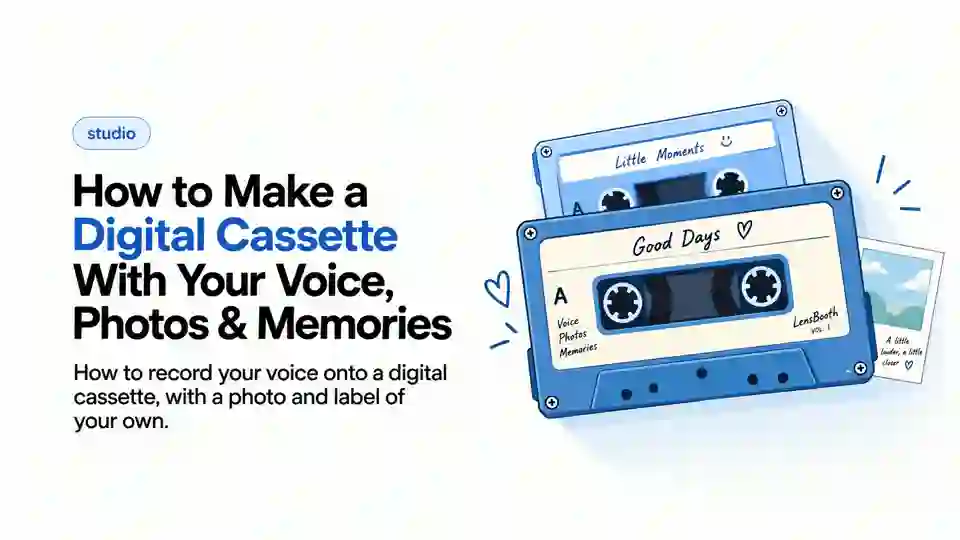
A voice note is a recording. A digital cassette is a recording someone opens on purpose. The audio can be identical - what changes is everything around it: a cover you designed, a label with a photo and a date on it, and a small ritual on the other end before the voice actually plays. That's what turns a thirty-second clip into something worth keeping.
Here's what a digital cassette actually is, what you can put on one, and how to make one in LensBooth.
What is a digital cassette?
It's a voice recording wrapped in the format of a cassette tape rather than a bare audio file. Three things separate it from the alternatives:
Versus a normal voice note. A voice note is one tap and gone - no cover, no context, easy to lose in a chat thread. A cassette has a cover you customize and a label with a photo and text, so it looks like something rather than just sounding like something.
Versus a static photo. A photo freezes a moment but says nothing in your own voice. A cassette does the opposite - it's built around the voice, with the photo as a supporting element rather than the whole thing.
Versus a generic audio recorder. A plain recording app gives you a file. A cassette gives the person receiving it a small physical-feeling moment - they watch it slide into a player before it starts, rather than just pressing play on a waveform.
None of this changes what a recording actually is technically. What changes is the presentation, and presentation is most of what makes something feel worth keeping rather than worth deleting once it's been heard.
What can you put on a digital cassette?
- Your voice. The core of it - an actual recording, not typed text read aloud by anything else.
- One photo. Cropped, repositioned and zoomed until it sits right on the label.
- Short text. A line or two - a title, a name, a note.
- An optional date. When it was made, or a date that matters to what you're saying.
- A cover and label design. Customize how the cassette itself looks before anything else goes on it.
How to create a digital cassette in LensBooth
- Open Cassette Studio. Go to LensBooth Cassette to start.
- Choose and customize a design. Pick a cassette style and adjust the cover and label.
- Add your photo. Crop, reposition and zoom it until it fits the label.
- Add text and a date, if you want them. Both are optional.
- Record your voice. Start recording whenever you're ready.
- Preview it. Listen back before deciding it's done.
- Re-record if it's not right. No limit on doing it again until it sounds how you want.
- Broadcast or share it. Send it once you're happy with it.
- The receiver plays the cassette. They watch it slide into a player, then press play to hear you.
Nothing about the process needs an account, and it runs in the browser on desktop or mobile.
Digital cassette ideas
- Birthday voice message. Says more than a written message, and takes about the same effort.
- Long-distance message. For when a text feels too flat for what you actually want to say.
- Travel memory. Record while somewhere, or talk about it afterward - both work, and the photo can be from either moment.
- Friendship message. Not everything has to be romantic; a cassette for a friend works exactly the same way.
- A personal story. Something you'd rather tell than type - longer stories tend to survive better as voice than as a wall of text.
- An audio-memory snippet. A short recollection of one specific moment, kept exactly as it sounded when you first said it out loud.
If you plan to include a song or melody, make sure you actually hold the rights to it or that it's genuinely yours to share - LensBooth doesn't grant any license to use someone else's music.
Why add a photo to a voice message?
A recording on its own has no anchor - months later, it's not always obvious what the voice was even talking about. A photo pins it to a specific moment, the same way a caption pins a picture. Put the two together and each one fills in what the other is missing: the photo shows what things looked like, the voice explains what it felt like at the time.
It also changes how the recording gets received. A voice note that arrives with no context asks the listener to guess what they're about to hear. A cassette with a photo and a date already tells them roughly what it is before they press play - they're choosing to listen, not being ambushed by an unlabeled file.
If your message doesn't have one recipient
A cassette is built for a specific person. If what you actually want is to hear a voice that isn't addressed to you at all - or leave one for a stranger rather than someone you know - LensBooth Radio is the format built for that instead.
Frequently Asked Questions
What is a digital cassette?
A voice recording presented as a customizable cassette tape, with your own photo and short text on the label, that the recipient opens like a physical cassette before it plays.
Can I record my own voice on a digital cassette?
Yes, that’s the core of it - you record, preview, and can re-record as many times as you want before sending.
Can I add a photo to a digital cassette?
Yes, one photo, which you can crop, reposition and zoom to fit the label.
How is a digital cassette different from a normal voice message?
A normal voice message is a bare recording. A cassette wraps the same recording in a cover and label you design, with a photo and text, and the receiver watches it load into a player before it plays.