
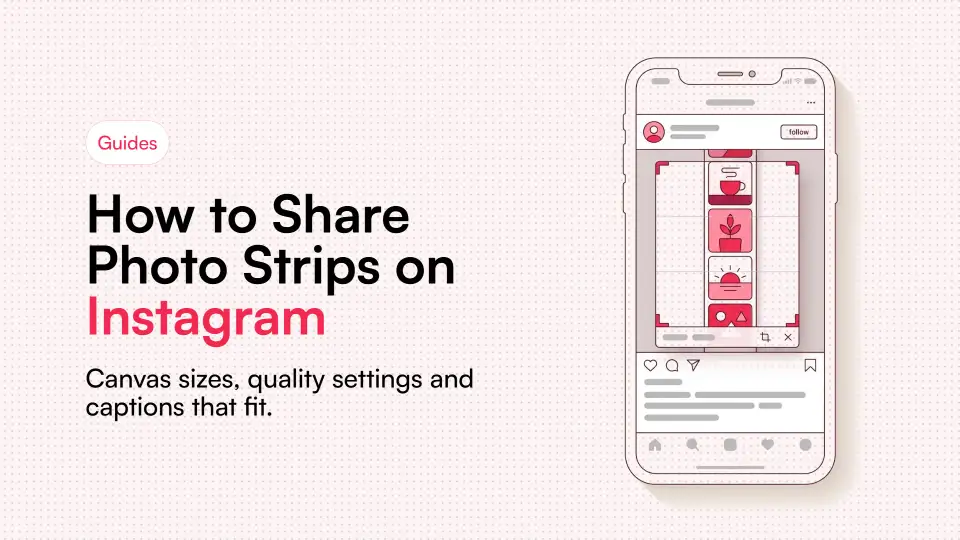
You take a photo strip you actually like, upload it to Instagram, and the app immediately crops the top and bottom off, compresses what is left, and turns four crisp frames into a blurry vertical smear. This is the single most common complaint about sharing strips online, and it has one root cause.
A photo strip is roughly a 1:3 rectangle. Instagram's tallest supported feed ratio is 4:5. The strip is more than twice as tall as anything the platform will display, so something has to give - and by default, Instagram decides what.
The fix is to stop uploading the strip and start uploading a canvas with the strip on it. Here is how to do that for every placement, plus what to write underneath.
Why Instagram crops your strip
Instagram supports three feed shapes: square (1:1), portrait (4:5) and landscape (1.91:1). Stories and Reels use 9:16. Nothing on the platform displays a 1:3 image at full height.
| Placement | Ratio | Pixels | Fits a 1:3 strip? |
|---|---|---|---|
| Feed portrait | 4:5 | 1080 × 1350 | No - crops heavily |
| Feed square | 1:1 | 1080 × 1080 | No - crops severely |
| Stories / Reels | 9:16 | 1080 × 1920 | No, but closest |
| Strip on a canvas | any of the above | as above | Yes |
When you upload something taller than 4:5, Instagram centre-crops to fit. You lose the first and fourth frames, which are usually the two best ones. Then it re-encodes the result, and because the remaining image is being scaled down from something very tall, the compression is harsher than usual.
The fix: put the strip on a canvas
Instead of asking Instagram to fit a 1:3 image into a 4:5 slot, you build a 4:5 image that happens to contain a 1:3 strip. Instagram then has nothing to crop, because the file already matches the shape it wants.
The 60-second method, on your phone
- Open any free layout or collage app, or use Instagram's own Layout tool.
- Create a blank canvas at 1080 × 1350 for a feed post.
- Set the background to a solid colour - cream (#F4F4F0), white, or black all work well.
- Drop the strip in and scale it until there is roughly 40-60 px of breathing room above and below.
- Export at maximum quality and upload that.
If you want it larger in the feed
A 1:3 strip centred on a 4:5 canvas is small - it occupies about 40% of the frame width. Two alternatives make it bigger: rotate the strip 90° and lay it horizontally across a 4:5 canvas, or split the strip into two halves of two frames each and place them side by side. Both keep all four frames visible at a much larger size.
Stories: the best placement for a strip
Stories are 9:16 - 1080 × 1920. That is the tallest canvas Instagram offers and by far the most natural home for a photo strip. A 1:3 strip on a 9:16 background can be shown at close to full height with room to spare.
- Export the strip at 600 × 1800 or larger.
- Open a new Story, choose a solid colour background (tap the draw tool, pick a colour, then press and hold the screen to flood-fill).
- Paste the strip in from your camera roll - copy the image first, then a "Add sticker" prompt appears in the Story editor.
- Scale it to about 85% of the screen height and centre it.
This is the placement most people should use. It shows the whole strip, it is the format friends are most likely to reply to, and the compression on Stories is gentler than on feed posts because the file is being displayed at close to its uploaded size.
Keeping the quality: what actually causes the blur
Instagram re-encodes everything you upload. You cannot prevent that, but you can stop it being severe.
- Upload at 1080 px wide. Not 2000, not 4000. Instagram scales everything to 1080 px, and its own downscaling algorithm is worse than the one on your phone. Give it a file that needs no resizing.
- Upload from the phone app, not the desktop web uploader. The web uploader applies heavier compression.
- Avoid uploading over a poor connection. Instagram serves a lower-quality version when it detects a slow network, and that version sometimes persists.
- Turn on "Highest quality uploads" in Settings → Data usage. It is off by default on many accounts.
- Use JPEG, not PNG or HEIC. Instagram converts everything to JPEG anyway; giving it a PNG just means it converts twice.
The biggest single factor is the first one. A 4000 px-wide upload gets downscaled by 74%, and Instagram's resampling is where most of the softness comes from.
Other platforms, briefly
TikTok
Full-screen 9:16, same as Stories. A strip fills a TikTok frame beautifully. Photo mode posts work well; if you want movement, a slow vertical pan down the strip reveals the frames one at a time and is far more effective than a static image.
The one platform that genuinely likes tall images. Pinterest recommends 2:3 and supports up to 1:2.1 before truncating in the feed. A photo strip is close enough that it performs unusually well here, and Pinterest is the only major platform where you can upload something close to the raw strip and have it look right.
WhatsApp and iMessage
Both compress aggressively by default. On WhatsApp, send it as a document rather than a photo to preserve the original file. On iMessage, disable "Low Quality Image Mode" in Settings → Messages.
X / Twitter
Crops to 16:9 in the timeline but shows the full image when tapped. A strip works, but expect it to appear as a thin sliver until someone opens it. Adding it to a canvas helps here too.
What to write underneath
A photo strip caption should do one of three things: date it, name the moment, or say nothing much at all. Long explanatory captions fight with the images.
- The date and place. "Tuesday. The kitchen." Understated and ages extremely well.
- The context in six words. "First time all six of us since March."
- A line from the conversation that was happening when the timer went off. Specific, unexplainable, and much funnier to the people who were there.
- Nothing. A strip with no caption is a confident post.
If you want a longer list to pick from, there are 120 of them in photo strip caption ideas, sorted by mood.
Hashtags, honestly
Hashtags do far less than they used to. Instagram deprecated hashtag following in 2023 and the algorithm now leans heavily on engagement signals and on-image text. Thirty hashtags will not rescue a post.
Three to five specific, genuinely relevant tags are enough - the kind a real person might browse rather than the kind a bot farm uses. If the strip is from a wedding, tag the venue. If it is from a city, tag the city. Location tags consistently outperform generic hashtags for small accounts.
The thing that actually drives reach on a photo strip post is that it is unusual in a feed of single images. Four frames of the same people making four different faces stops the scroll on its own.
A short checklist
- Export the strip at 600 × 1800 or larger.
- Build a canvas: 1080 × 1350 for feed, 1080 × 1920 for Stories.
- Centre the strip with even margins. Solid background, no decoration.
- Export as JPEG at 1080 px wide.
- Upload from the phone app with high-quality uploads enabled.
- Caption short. Location tag over hashtag.
If your strip is not sharp enough to survive this, the problem is upstream - see how to make your webcam photos look better. And if you need a strip to start with, the LensBooth booth runs in your browser and exports at a size that holds up to all of the above.
Frequently Asked Questions
Why does Instagram crop my photo strip?
A photo strip is about a 1:3 ratio and Instagram's tallest supported feed format is 4:5. Anything taller gets centre-cropped automatically, which usually removes the first and last frames. Placing the strip on a 1080 × 1350 canvas before uploading prevents it.
What size should a photo strip be for Instagram Stories?
Build a 1080 × 1920 canvas (9:16) and place the strip on it at roughly 85% of the screen height. Stories are the tallest canvas Instagram offers, which makes them the most natural placement for a strip.
How do I stop Instagram blurring my photo strip?
Upload at exactly 1080 pixels wide rather than something much larger - Instagram downscales everything to 1080 px and its own resampling is where most of the softness comes from. Also enable "Highest quality uploads" in Settings, and upload from the phone app rather than the desktop web uploader.
Can I post a photo strip on Pinterest without cropping?
Pinterest handles tall images better than any other major platform - it recommends 2:3 and tolerates up to about 1:2.1. A photo strip is close enough that it usually displays well without being placed on a canvas first.
How many hashtags should I use on a photo strip post?
Three to five specific ones is plenty. Instagram removed hashtag following in 2023 and now weights engagement far more heavily. A location tag typically does more for reach on a small account than a block of thirty generic hashtags.
What is the best way to share a vertical photo strip on Instagram without cropping?
Because standard photo strips have a 1:3 vertical aspect ratio, placing the strip onto a 9:16 background canvas (1080x1920 pixels) for Instagram Stories or a 4:5 canvas (1080x1350 pixels) for feed posts prevents Instagram from cropping out the top and bottom frames.
Sources and further reading
- Aspect ratio - How ratios are expressed, and what gets cropped when a tall strip meets a square frame.
- Dots per inch (DPI) - What 300 DPI actually means, and why a strip that looks sharp on screen can print soft.